
Taylor County Court Records After a Jail Arrest
The path runs in a clear order. A local agency makes an arrest, the person is booked at the Taylor County Jail, and the roster posts booking-level charges, bond, holds, and an arresting officer. Then the State Attorney for the Third Judicial Circuit reviews the case and decides what formal charges to file. That filing is the moment the court record really starts. From there the Taylor County Clerk of Court keeps the case file as it moves through hearings to a final outcome.
It helps to separate two things. The arrest and booking side lives with the sheriff, and the jail inmate records page covers the roster, while the jail mugshots page covers booking photos. The court record is the charges the prosecutor actually filed and how the case played out. Court records after an arrest are not the same as the arrest report, and reading the booking charge as the final charge is a common mistake.
How to Find Taylor County Court Records After an Arrest
The Taylor County Clerk of Court and Comptroller, led by Clerk Gary Knowles, keeps the criminal case files. The Clerk's site links a Local Official Record Search at pubrecords.taylorclerk.com, but that portal is built around recorded official records and carries a disclaimer that it is not the official court record and should not be relied on for legal action. For a specific criminal case, the safest route is to contact the Clerk directly.
- Open the Clerk's public search at pubrecords.taylorclerk.com and try a name search.
- Use the last name, then add a first name, suffix, or date range to narrow it.
- Open a matching record and read the parties, document type, and dates.
- For a full criminal case file, call or visit the Clerk at 108 North Jefferson St., Perry, FL 32347, (850) 838-3506.
Statewide criminal-history lookups run through the Florida Department of Law Enforcement, which handles formal background checks and the seal-or-expunge eligibility certificate. This research did not find a free statewide public criminal docket search, so a single county case is best reached through the local Clerk. The Clerk's criminal page is the plain-English guide to which court handles which case, and the Clerk's office can confirm a case number when the recorded-records portal comes up short.
The Clerk's criminal-court page explains felony, misdemeanor, and juvenile jurisdiction and points to sealing and expunging.
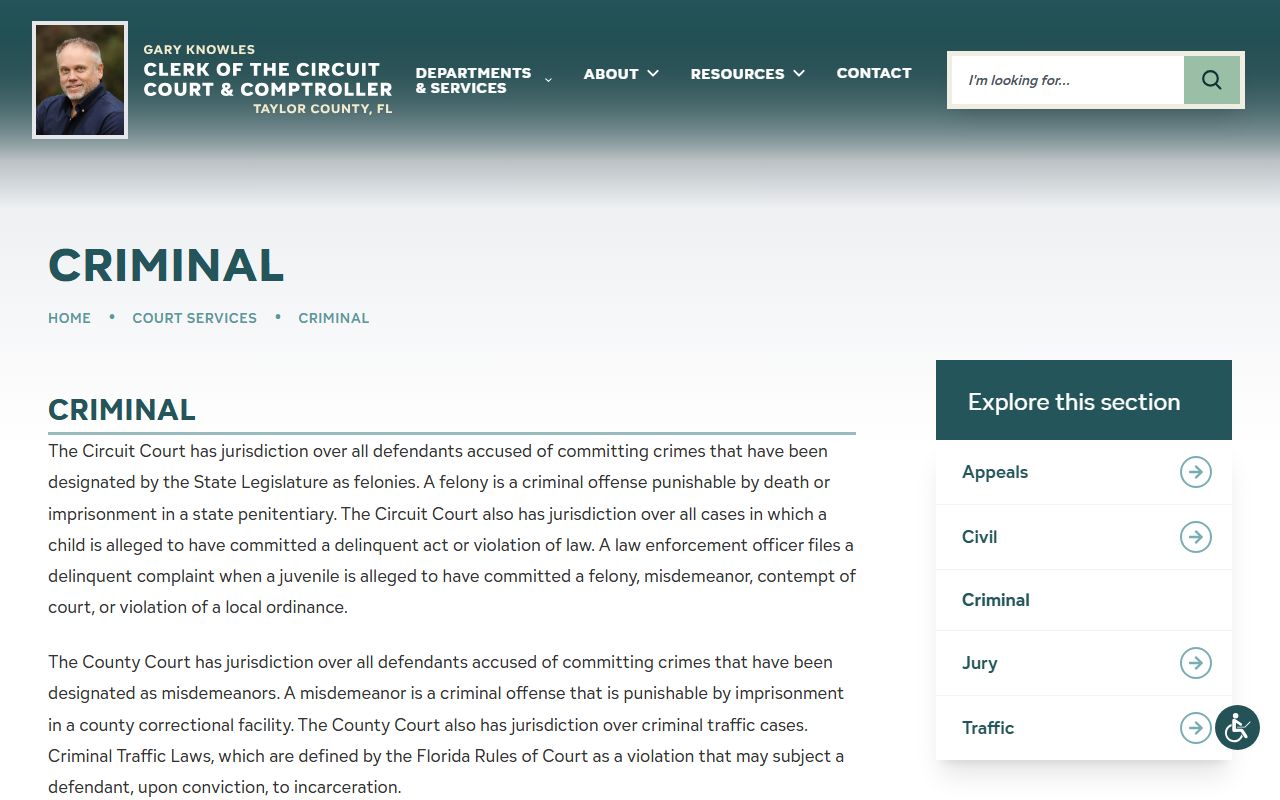
Reading that page first tells you whether a case sits in Circuit Court or County Court before you start searching.
Search Fields in the Taylor County Records Portal
The Clerk's public search accepts a set of name and filter fields. Only the last name is marked required for a name search. The portal shows official records recorded after May 8, 1981, runs around the clock except for a Sunday early-morning window and maintenance, and notes that its general records were verified through a recent date at inspection. Treat it as a recorded-document search rather than a full criminal docket.
| Field Label | Type | Required | Notes |
|---|---|---|---|
| Last Name | Text | Yes | Marked with an asterisk for a name search. |
| First / Middle Name | Text | No | Narrow a common name. |
| Party Type | Filter | No | Both, From, or To. |
| Suffix | Dropdown | No | JR, SR, II, III, and so on. |
| Document Type | Dropdown | No | Includes bond, dismissal, judgment, order, and warrant types. |
| Start / End Date | Date | No | Entered as mm/dd/yyyy. |
| Limit To | Filter | No | 10, 20, 50, or show all results. |
A document type in that list, such as a warrant or a bond entry, does not mean a full criminal case docket is online, which is why the Clerk's office remains the route for a complete case file.
How Charges Get Filed After an Arrest: Complaint, Information, and Indictment
Booking happens at the jail, but the charge record begins when a charging document is filed. In Florida, the Circuit Court has jurisdiction over felonies, and the County Court handles misdemeanors and criminal traffic. The prosecutor can file by information for many cases, while a grand jury indictment is used for the most serious felonies. Each path opens the court case that follows the arrest.
| Complaint | Information | Indictment | |
|---|---|---|---|
| Filed By | Officer or prosecutor | State Attorney | Grand jury |
| Common For | Initial charge at booking | Many felonies and misdemeanors | Capital and serious felonies |
| Starts | The custody record | The court case | The court case |
Charge Status in Court Records After an Arrest
Charges are not fixed once a person is arrested. As a case moves, a charge can be amended, reduced, added, or dropped. The booking charges on the jail roster can differ from what the prosecutor finally files, and a court or offense number on a booking may not match the final Clerk case number. The status terms below show up across court records after an arrest.
| Status | What It Means |
|---|---|
| Pending | The charge is still open and moving through the court. |
| Amended / Reduced | The charge was changed or replaced with a lesser one after filing. |
| Dismissed | The charge ended without a conviction. |
| Nolle Prosequi | The prosecutor chose not to pursue the charge. |
Use the roster for the immediate custody picture and the Clerk, the State Attorney, and the court file for the formal charge and the outcome.
Bond and Release After an Arrest
Bond can appear at two stages. The jail roster may show a booking bond amount and a cash-only figure, while a judge sets or reviews release at first appearance. The court file can later show different conditions if charges change or a judge modifies release. A hold from another agency or court can keep a person in custody even when a bond amount is posted, so read the holds line before assuming release is possible.
| Bond Type | How It Works |
|---|---|
| Cash Bond | Paid in cash or certified funds; the roster tracks a separate cash-only amount. |
| Surety Bond | Posted through a licensed bail agent for a fee. |
| Recognizance (ROR) | Release without upfront money, usually with conditions set by the judge. |
| No-Bond Hold | A status or hold that blocks release on bond at that point. |
Taylor County does not publish a detailed bond-payment page or a bondsman process, so confirm a current bond amount, any holds, and accepted payment with the jail at (850) 584-4333 before traveling.
Warrants That Lead to an Arrest
An outstanding warrant is a common road to a booking. The sheriff's homepage advertises an open-warrant search, but no working public search form with fields was located, so the reliable fallback is the Civil Process and Warrant unit. That division serves and returns court process and reports handling more than 1,500 warrants, writs, summons, injunctions, and court orders a year. For a warrant question, call the administrative office at (850) 584-4225, and check the Clerk at (850) 838-3506 for a bench warrant or capias tied to a court case. Once a person is arrested on a warrant, the booking and any related hold show up on the jail roster.
Charges vs. Convictions
An arrest and a charge are accusations, not proof of guilt. A booking record shows what an officer alleged, and a court charge is what the prosecutor filed. A conviction only comes from a plea or a verdict later in the case. Keep that difference in mind when reading any court record after an arrest.
| Charge | Conviction | |
|---|---|---|
| Stage | Accusation | Verdict or plea |
| Burden of Proof | Probable cause | Beyond a reasonable doubt |
| Public Record | Yes | Yes |
Sealed vs. Expunged Records After an Arrest
Florida law lets eligible people seal or expunge a record after a dismissal or another qualifying outcome. The Taylor County Clerk's criminal page points to the sealing and expunction statutes and notes that a Certificate of Eligibility from the Florida Department of Law Enforcement comes first, before a person petitions the court. Sealing hides a record from public view, while expunction goes further and treats it as if it had been removed.
| Sealed | Expunged | |
|---|---|---|
| Visibility | Hidden from public view | Removed from public access |
| Law Enforcement | Limited access remains | Very limited access |
| Eligibility | Florida Statutes § 943.059, after FDLE certificate | Florida Statutes § 943.0585, after FDLE certificate |
Background Check Considerations
A casual court-records lookup is not the same as a regulated background check. A formal screening for employment, housing, or credit must follow the federal Fair Credit Reporting Act and use a licensed provider. Reading a public court file for your own information does not.
Important: The information here is not a consumer report under the FCRA, and it may not be used for employment, tenant, credit, or insurance screening.
Restricted Court Records After an Arrest in Taylor County
Some records after an arrest are limited or closed. Juvenile delinquency matters are handled separately, and sealed or expunged cases drop out of public view. The sheriff also withholds an active report, or one sent to the court for review, from anyone but the victim until the case closes. The Clerk's recorded-records portal shows only items the Florida statutes treat as public, displays records back to May 8, 1981, and does not show Social Security numbers. When a record is restricted, the route is a direct request to the office that holds it.
The State Attorney for the Third Judicial Circuit, John Durrett, is the charging authority for Taylor County and six neighboring counties.
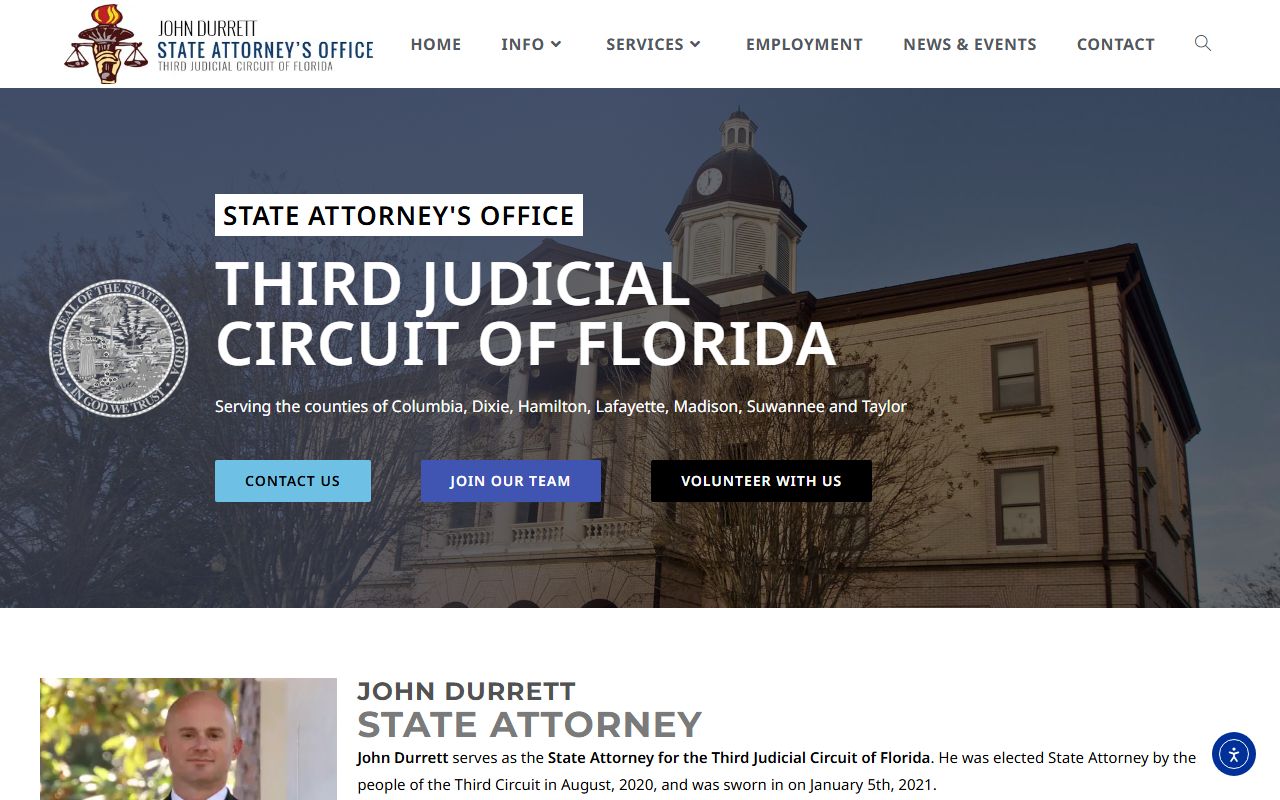
That office decides the formal charges, while the Clerk keeps the case file and the sheriff keeps the arrest and booking records. The Third Judicial Circuit covers Columbia, Dixie, Hamilton, Lafayette, Madison, Suwannee, and Taylor counties, and its public-records contact is listed as Dana Brady-Giddens at (386) 362-2320. To match a jail booking to a court file, copy the full name, the booking number, the booking date and time, the statute, and the court or offense number, then bring those details to the Clerk.